
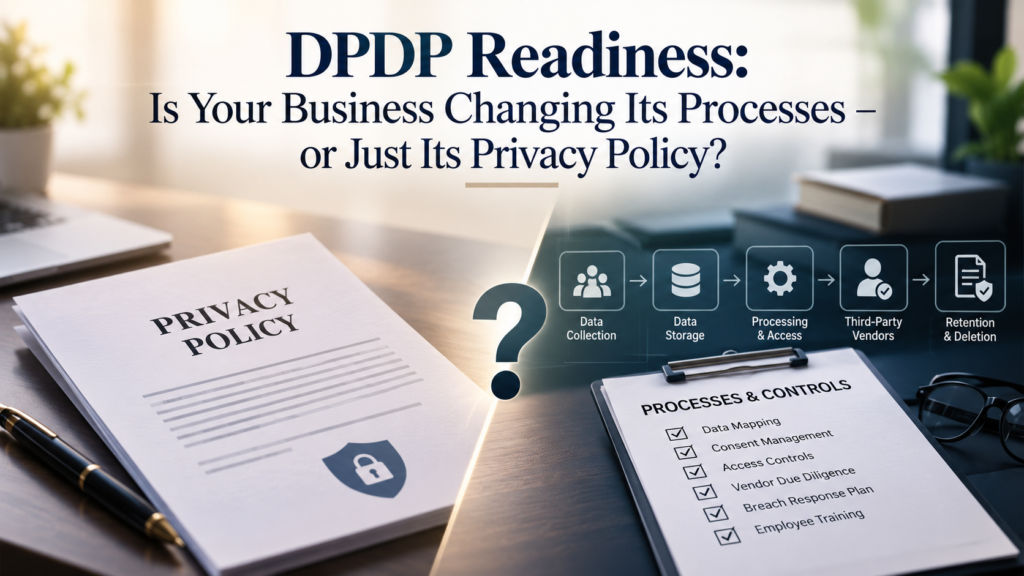
Every penny that a business makes can be accounted for. Can it, however, account for all the personal data it gathers?
Everyday operations include the collection of customer information, employee data, contact information, addresses, and transaction histories. Some data is shared, some is actively used, and some is retained for years.
The majority of companies are aware of why they gather personal information. However, how many businesses are aware of what happens to it afterward?
This distinction is becoming more crucial with India’s Digital Personal Data Protection (DPDP) Act, 2023.
What Does the DPDP Act Mean for Your Business?
The DPDP Act establishes a legal framework for the collection, use, storage, and sharing of digital personal data. It aims to protect individuals’ personal data while recognising that businesses may legitimately need to process such information in the course of their operations.
Consider a buyer who purchases a product online. They provide their name, phone number, and delivery address. The company uses this information to fulfil the order.
But what happens when the product is delivered?
The customer’s information may be stored in the company’s database, used for marketing purposes, or shared with third-party service providers. The information obtained for a single transaction may continue to remain within multiple systems long after the transaction itself has been completed.
The DPDP Act addresses these practices by establishing obligations relating to transparency, consent where required, data security, and individuals’ rights over their personal information.
The Policy Has Changed. Is the Process Complete?
With the notification of the DPDP Rules, 2025, the law is being implemented in phases, with several critical corporate responsibilities scheduled to take effect in May 2027.
Many companies may view updating their privacy policies as an appropriate response to the changing regulatory environment.
The policy has been rewritten, the website has been updated, and all relevant disclosures have been implemented.
On paper, the business appears to be well prepared.
But consider what goes on behind the scenes.
A privacy policy may state that personal data will be retained only for as long as necessary. Yet inactive customer records may continue to exist across internal databases, archived systems, vendor platforms or legacy records.
The policy may also describe the purposes for which data is used, while the same information continues to move across departments and external service providers in ways that may not always be immediately visible.
The wording may have changed. The company’s actual data-handling practices may not have changed with it.
When Business Reality and Paper Compliance Come Together
Customer registrations and online forms are not the only sources of personal information. Personal data may pass through vendor connections, accounting systems, marketing, sales, and human resources.
One department may collect the data, another may store or use it, while an external service provider may also have access to it.
This can create a gap between what a company says in its privacy policy and what actually takes place in its operations.
A well-drafted policy might clarify an organization’s commitments, but it does not automatically mean that those commitments are reflected in daily operations.
This discrepancy between documentation and actual processes becomes increasingly important as the DPDP framework moves towards wider operational implementation.
Beyond the Paperwork, Is Your Organization Properly Prepared?
The DPDP Act places data protection within a much broader conversation around corporate responsibility, internal processes, governance and regulatory compliance.
Customers may be able to see an updated privacy statement. What they may not see are the processes, systems and controls that sit behind it.
And that’s where the real readiness question begins.
Would your company’s actual practices reflect the promises made in its privacy policy if it were required to demonstrate how personal data is collected, used, stored and shared?
Is your company simply preparing its paperwork – or is the business itself being prepared for DPDP compliance?
The real test of DPDP readiness may therefore not be what your privacy policy says. It may be whether your organisation can demonstrate that its people, systems, vendors and internal processes actually follow it.
If your business were asked to demonstrate that tomorrow, would the policy and the process tell the same story?
Connect with Zeus Advisors to understand what DPDP readiness means for your business and identify the compliance gaps that may exist beyond the paperwork.